
How to Search the Orange County Court Docket
Begin with whatever paper started the matter. The notice, citation, or old filing names the exact court. That court tells you where its docket lives. Orange County relies on iDocket for county and district cases. Those must take part in that service. For a broader look, re:SearchTX covers participating electronic records across the state. Neither tool is the last word. The statewide repository leans away from criminal records. Justice of the Peace or municipal cases often sit with their own courts.
Before you run any docket search, gather the cause number, the full case style, the court, the filing date, and each party's role. The cause number is your best key. Names repeat, spellings drift, and loose matches mislead. When nothing turns up online, use the phone, mail, public-computer, or counter channel the clerk publishes.
- Identify whether the case belongs to a District Court, County Court at Law, Justice Court, or municipal court.
- Open iDocket or the correct city portal and choose Orange County and the court when that choice is offered.
- Search by cause number first, then try a party name, attorney, date, or offense field if available.
- Read the event list for filings, settings, court assignment, and disposition. Confirm any date with the court.
- Ask the proper clerk for the exact document when a plain or certified copy is needed.
Orange County iDocket Limits
For county and district courts, the Orange County iDocket entry is a solid first stop. Its help material lets you search by litigant, attorney, county, court, date, and offense. Which fields actually appear depends on the participating court. A hit may list the case number. It may also show the category, the parties, and a running chronology of events.
Keep the service in perspective. iDocket is a vendor, not part of Orange County government. A screen result can point you to a file. But it cannot certify anything or prove the list is complete. If a result clashes with a notice or looks stale, call the clerk who holds the record. That could be the Orange County District Clerk, the Orange County Clerk, the JP clerk, or the city court.
The iDocket search description lays out the full range of search dimensions. It also explains why multiple search paths can exist. Not every Orange County court exposes each field. Whatever the screen shows, the Orange County court docket gets its final check from the clerk.
What an Orange County Court Docket Shows
Think of a docket as a timeline with a status attached. It usually carries the cause number, court, case type, public party roles, attorneys, filed items, hearing settings, orders, costs, and disposition. One caution matters here. An entry saying an order was filed is not the signed order itself. When the wording of that document counts, request the image from the clerk.
| Cause number | The court's unique case key and the safest search term. |
|---|---|
| Parties | Public names and roles such as plaintiff, defendant, applicant, or respondent. |
| Case events | Filed pleadings, notices, process, motions, and orders listed by date. |
| Settings | The hearing date, time, courtroom, judge, and setting type when published. |
| Court | The numbered District Court, County Court at Law, JP precinct, or city court. |
| Disposition | The recorded outcome or status, which may need the signed order for context. |
Orange County Docket Terms
Short labels hide wide differences. Orange County posts no single local event-code dictionary, so take unfamiliar codes to the responsible clerk instead of guessing.
- Setting
- A scheduled court event, not always the final trial.
- Reset
- A setting moved to a new date. It does not mean the case was dismissed.
- Disposition
- The result recorded for a charge, claim, or case.
- Capias
- A court order directing that a person be taken into custody.
- Return of service
- A filing that reports whether and how process was delivered.
Read the date, the event name, and the later entries as one picture. A corrected or reset entry can control over an earlier Orange County docket setting.
Which Orange County Courts Keep Dockets
Record custody in Orange County is split. The District Clerk holds files for the 128th, 163rd, and 260th District Courts. The County Clerk keeps County Court at Law civil, misdemeanor, probate, and juvenile records. Four JP offices and each municipal court run their own lower-court dockets.
| Court | Docket Covers | Where to Search |
|---|---|---|
| 128th, 163rd, and 260th District Courts | Felony, district civil, family, and delinquent tax cases | Orange County District Clerk, iDocket, and eligible re:SearchTX records |
| County Courts at Law 1 and 2 | Misdemeanor, county civil, probate, and juvenile matters | Orange County Clerk, iDocket, and clerk request channels |
| Justice Courts 1 through 4 | Class C cases, small claims, justice civil, eviction, and magistrate work | The individual JP clerk and court forms |
| Municipal Courts | City ordinance, traffic, and state-law Class C matters | The issuing city's court or portal |
Orange County's Split Clerks
One word will not get you far in an Orange County court docket request: “clerk.” This county splits the job. Felonies, divorces, district civil suits, and delinquent-tax cases sit with the District Clerk. Take a County Court at Law misdemeanor to the County Clerk instead. The same goes for a probate file, a county civil suit, or a juvenile matter. Anything from a lower court stays with that JP or municipal clerk.
Each office tells you how to route paper. The District Clerk posts separate routing lines for felony, civil, and family work. The County Clerk's records pages cover self-searching in person, mailed requests, copy charges, and e-filing. One habit saves money and time. State the cause number and court. Then ask which office truly holds the file before you pay anyone.
The official County Clerk search page lists its online record choices.
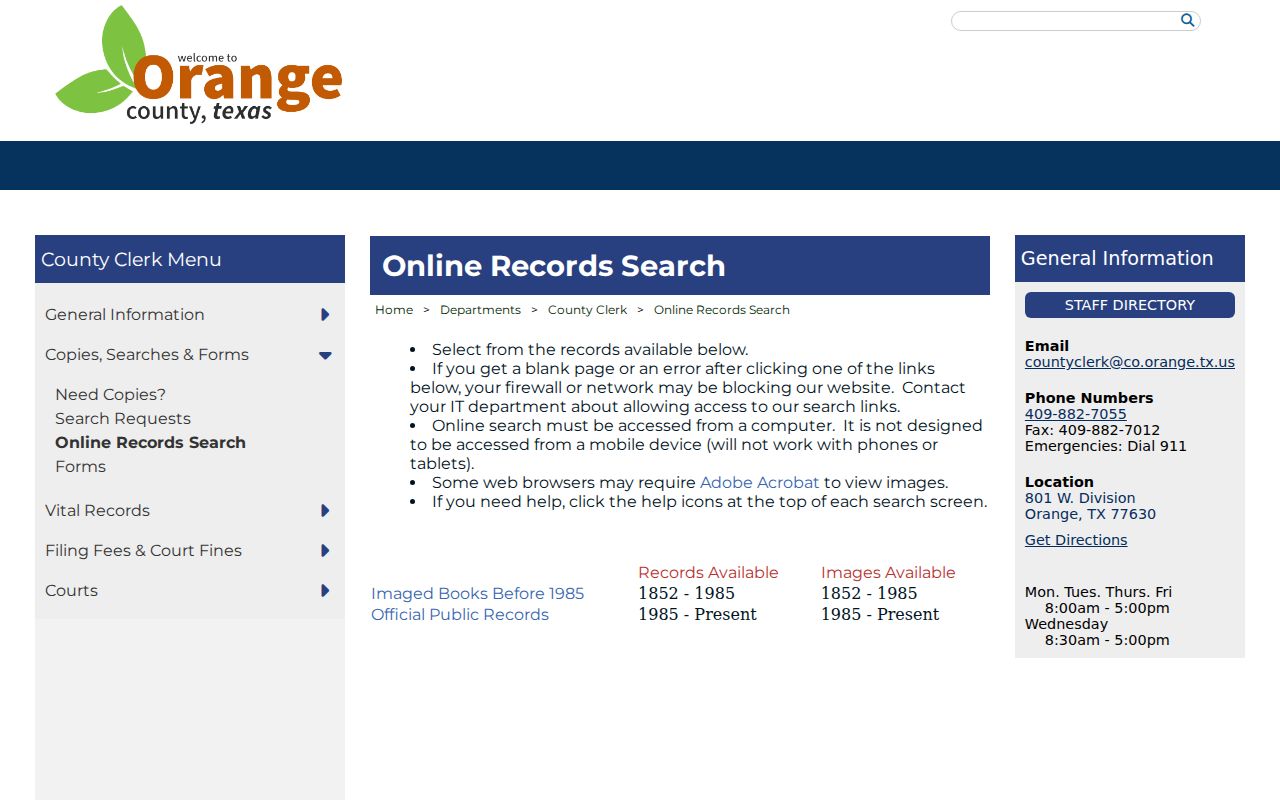
That official page helps you tell the clerk's imaged-book and Official Public Records tools apart from the routes that reach actual court-case dockets.
Quick answer: Court level controls custody. The place where an event happened or a party lives does not decide which Orange County clerk owns the file.
Orange County Filing Versus Search
eFileTexas delivers filing envelopes to Texas courts, and that is where its job ends. It is not the public Orange County court docket. Once a filing clears review, its details may show up in the court's case-management record. Eligible electronic documents may open through re:SearchTX. Local filing codes, fees, paper exceptions, and probate steps still come from the Orange County clerk.
The County Clerk e-filing page carries special business rules. Its November 2025 update deals with attorney email details, service fees, probate-hearing packets, ad-litem codes, and occupational-license orders. Those instructions are exactly why a statewide portal cannot replace local review.
Process: Filing envelope › clerk review › accepted case event › court setting › signed order › copy request.
Finding Orange County Court Dates
A setting can be many things. Arraignment, status conference, pretrial event, docket call, hearing, or trial. So check the event type, not just the date. County Clerk staff can give you a date. But their FAQ sends anyone seeking a reset to the court coordinator. Only the court moves a setting.
Then compare the newest docket event with the notice the court sent you. Do they differ? Call the clerk or coordinator named on the official court page. The detailed Orange County court calendar path walks through phone, counter, portal, and statewide checks.
Missing Orange County Hearing Dates
A missing date on an Orange County court docket can have several innocent causes. The case may sit in another court. A filing may not have posted yet. The setting may have been reset. Or the online source simply does not carry that case type. Run the cause number through the most likely county portal first. Then check the responsible court's official page. Criminal matters warrant extra care, since re:SearchTX is not a complete criminal index. When the case appears but the date is blank or stale, call the court coordinator. The District and County Courts at Law at 801 W. Division publish individual coordinator contacts. A clerk can confirm what the public record currently shows. The assigned court alone controls the schedule.
Note: A docket call is a case-management event. It should not be assumed to be the trial date.
Public Access to Orange County Court Dockets
Texas treats court case records under a judicial access system. That system stands apart from ordinary executive-agency records. Public access is the usual rule. Even so, sealed, juvenile, confidential, restricted, and redacted material may be withheld. And a document that is absent from an Orange County court docket does not prove that no case or event exists.
Key Rules:
Texas Judicial Branch Rule 12 policy explains requests for administrative judicial records and why case-record denials follow other law.
Texas Government Code Chapter 552 recognizes that the judiciary has a separate access regime.
Texas Rule of Civil Procedure 76a creates a strong presumption of access and sets the test for sealing civil court records.
Orange County Public Search Options
The internet is only one way in. On the County Clerk's online records page, imaged books before 1985 sit apart from Official Public Records dated 1985 forward. Those indexes do real work for the record sets they describe. Just do not treat them as a full court-case docket, because they are not one.
In person, the County Clerk opens its public computers and index books to visitors. Prefer to have staff look? The search-request page sets the terms: $5 per name, no phone or email searches, and mail requests that include the name, case type, approximate file date, contact details, and payment. The official Orange County request instructions lay out both the self-search and mail routes.
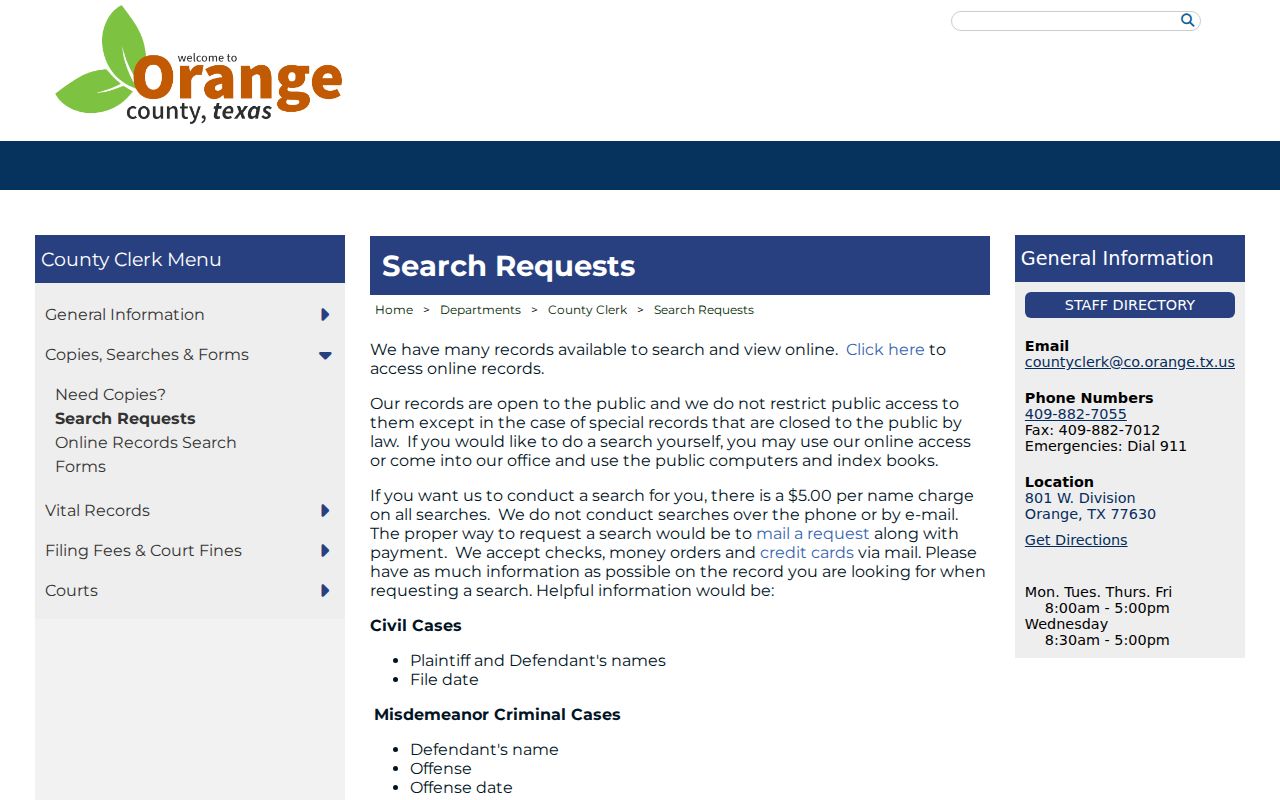
An Orange County docket search does not end just because one remote case screen comes up short. There are other ways to reach the court record you need.
Orange County Copies and Proof
Think of a docket entry as a pointer rather than the paper itself. It names a filing but does not show what the document says. Need the actual text? The Orange County Clerk takes copy requests in person or by mail for civil, probate, and misdemeanor criminal cases. Write down the style, the cause number, and the file date. Then name the exact pleading, return, order, judgment, or other item you want copied.
The posted fees are simple. A plain copy runs $1 per page, and certification adds $5 per case or document. A staff name search also costs $5. Fee schedules can change, so confirm the current amounts before you send a request.
| Request | Published amount | What to provide |
|---|---|---|
| Name search | $5 per name | Name, case type, and approximate file date |
| Plain copy | $1 per page | Cause number and exact document |
| Certification | $5 added per case or document | State that a certified copy is required |
The County Clerk FAQ is the source for the copy terms.
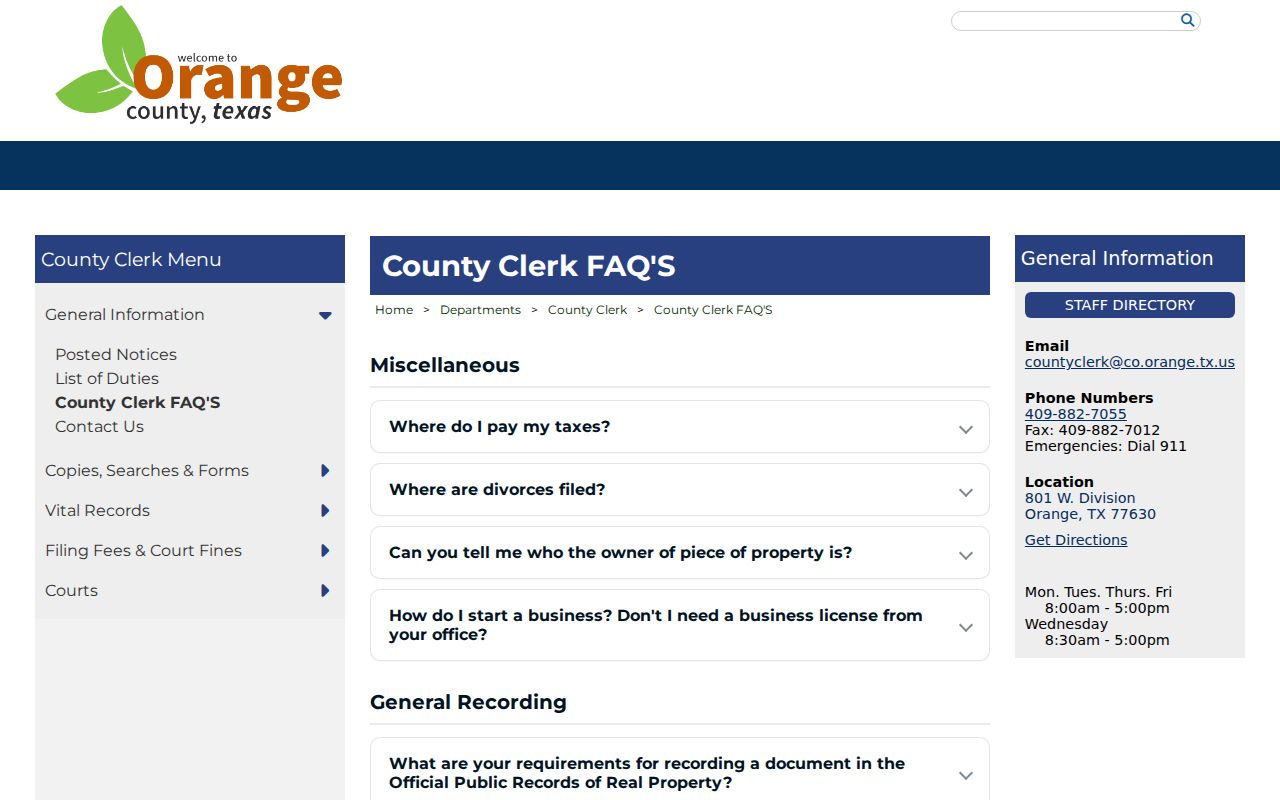
County guidance draws a clear line between a search fee, a per-page copy, and certification.
The Orange County Clerk and Docket Records
Two clerks work out of the same Orange County courthouse complex. Each keeps its own dockets. Public hours at both offices run 8:00 a.m. to 5:00 p.m. on weekdays. You will find the District Clerk in Room 206 and the County Clerk in Room 103. A quick call to the right division first can keep your mailed request or counter visit from landing with the wrong office.
Orange County District Clerk
801 W. Division, Room 206
Orange, TX 77630
409-882-7825
Orange County Clerk
801 W. Division, Room 103
Orange, TX 77630
409-882-7055
Orange County District Caseload
State fiscal 2024 numbers explain a lot. They show why an Orange County court docket can look messy at first glance. The reporting window stretched from September 1, 2023, through August 31, 2024. New filings only tell part of the story. District civil added 628 cases while disposing of 993. District family added 737 against 914 disposed. District criminal came in at 693 added and 792 disposed. So disposed, inactive, and reactivated entries can all appear on a single docket. None of them fit a simple new-case tally.
The criminal side had 715 reactivations and 647 cases placed inactive that same year. That is a useful caution for anyone reading an Orange County criminal docket. A case marked inactive is not a final result, and the count of added cases is not the whole picture of activity.
Court Dockets by City in Orange County
Municipal courts handle city ordinance matters, traffic cases, and state-law Class C dockets. The five city pages sit in 2020 Census incorporated-city order. Where a ticket starts depends on who wrote it. A city citation begins with the issuing municipal court. A county JP ticket, though, begins with the named precinct. Anything rising to higher criminal or civil levels routes to an Orange County clerk. That holds even when the event happened inside city limits.
Orange Court Docket
19,324 · Municipal sessions and an official citation search portal
Vidor Court Docket
9,789 · Published arraignment and contested-pretrial blocks
Bridge City Court Docket
9,546 · Class C, traffic, ordinance, and juvenile school matters
West Orange Court Docket
3,459 · Clerk-first case and citation requests
Pinehurst Court Docket
2,232 · City court procedure and payment channels
Map and Directions to the Orange County Courthouse
District Court files are kept by the Orange County District Clerk at the Orange County Courthouse, 801 W. Division Avenue in Orange, in Room 206, a short walk from the County Clerk's Room 103. The same complex houses County Court at Law 1 in Room 104, County Court at Law 2 in Room 203, and the 128th, 163rd, and 260th District Courts in Rooms 201, 303, and 304.
Orange County District Clerk
801 W. Division Avenue, Room 206
Orange, TX 77630
409-882-7825
Monday through Friday, 8:00 a.m. to 5:00 p.m.
The 2025 local rules bar courtroom photography, video, and recording without permission and require bailiff approval for packages or containers. No general visitor parking policy is published, so calling the District Clerk before the trip confirms both the file and the room.