
How to Search Civil Dockets
Gather the basics first. An Orange County civil docket search works best with a few key items. Bring the cause number, the court, the case style, and the filing date. District suits sit with the District Clerk. County Court at Law civil and probate matters belong to the County Clerk. Justice and small-claims cases stay with the named JP court. Orange County links to iDocket and re:SearchTX. The clerk's counter is the fallback for anything not visible online. Counter staff will not run searches by phone or email. Visitors can use public computers or index books instead. A written mail request asking staff to search a name costs $5. For district civil questions, call 409-882-7828; family or divorce questions go to 409-882-7829.
- Identify the court from a notice, petition, or prior order.
- Search the cause number first, preserving all punctuation.
- If needed, search the party name with the court and approximate file date.
- Compare the case style, party roles, and filing chronology.
- Request the exact pleading, order, or judgment from the proper clerk.
A search that comes back empty is rarely the last word. The wrong system, an older paper record, a spelling variation, or a restricted case can all hide an Orange County civil record from view, so a no-result does not prove the case never existed.
Orange District Civil Counter
District civil, family, and delinquent-tax papers all live with the Orange County District Clerk. The 128th, 163rd, and 260th District Courts are covered. Each of the three courts sits in a separate room with its own coordinator. That split matters when a docket shows a reset or setting. The clerk pulls the file. The coordinator confirms what happens next. The 128th District Court page lists Room 201, Judge Courtney Arkeen, and coordinator Latouia DuBois.
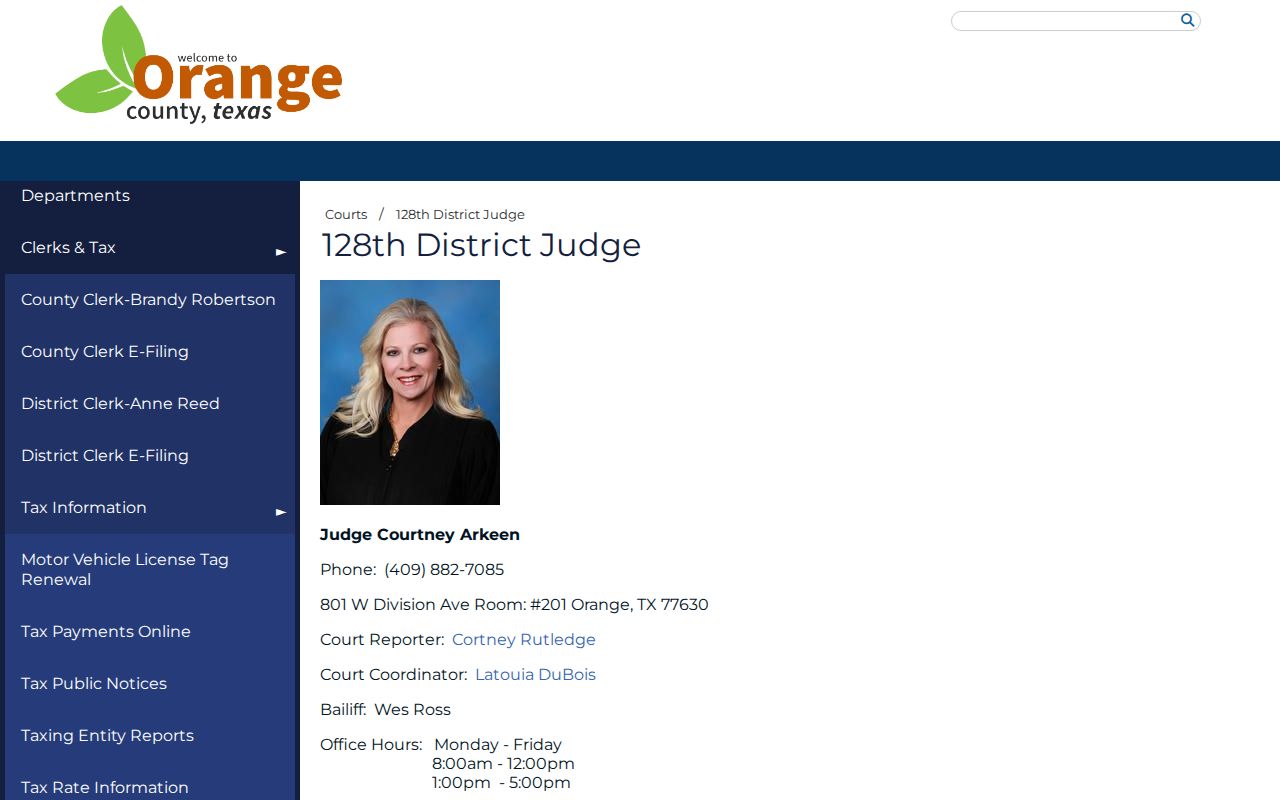
That official page gives the court-specific contact route behind any district civil docket entry. When writing to the District Clerk, name the cause number and the document, not just the judge.
What a Civil Docket Shows
Think of an Orange County civil docket as an indexed timeline of events. It names the court, cause number, case style, party roles, filing dates, service returns, motions, settings, orders, and case status. Read the full description and pull the underlying document before drawing any legal conclusion.
| Cause Number | The clerk-assigned locator, retained exactly as shown. |
|---|---|
| Case Style | The official caption and the named plaintiff, defendant, petitioner, or respondent roles. |
| Filing Event | A petition, answer, amended filing, motion, notice, or other lodged paper. |
| Service | Issuance and return entries; the filed return contains the details. |
| Setting | A hearing, docket call, or trial placement that should be confirmed with the coordinator. |
| Disposition | A dismissal, judgment, or other status, with the signed order supplying the terms. |
A docket line labeled "order" is not the order itself. Where public access allows, the Orange County clerk can supply a plain or certified copy of the filed document.
Orange Probate Docket Route
Probate runs through the Orange County Clerk, not the District Clerk's civil docket. This office files and indexes the Probate Minutes. It also issues the citations, subpoenas, and writs that a probate case needs. One local quirk stands out. The clerk's e-filing instructions carry one rule. Certain papers for a probate hearing must be handed over in person: proof of death, the order probating the will, the oath, and the bond. Those items skip e-filing entirely.
County Court at Law 2 hears these matters from Room 203 at 801 W. Division Avenue. Judge Rodney Townsend presides, and Darlene Guy coordinates the court's docket.
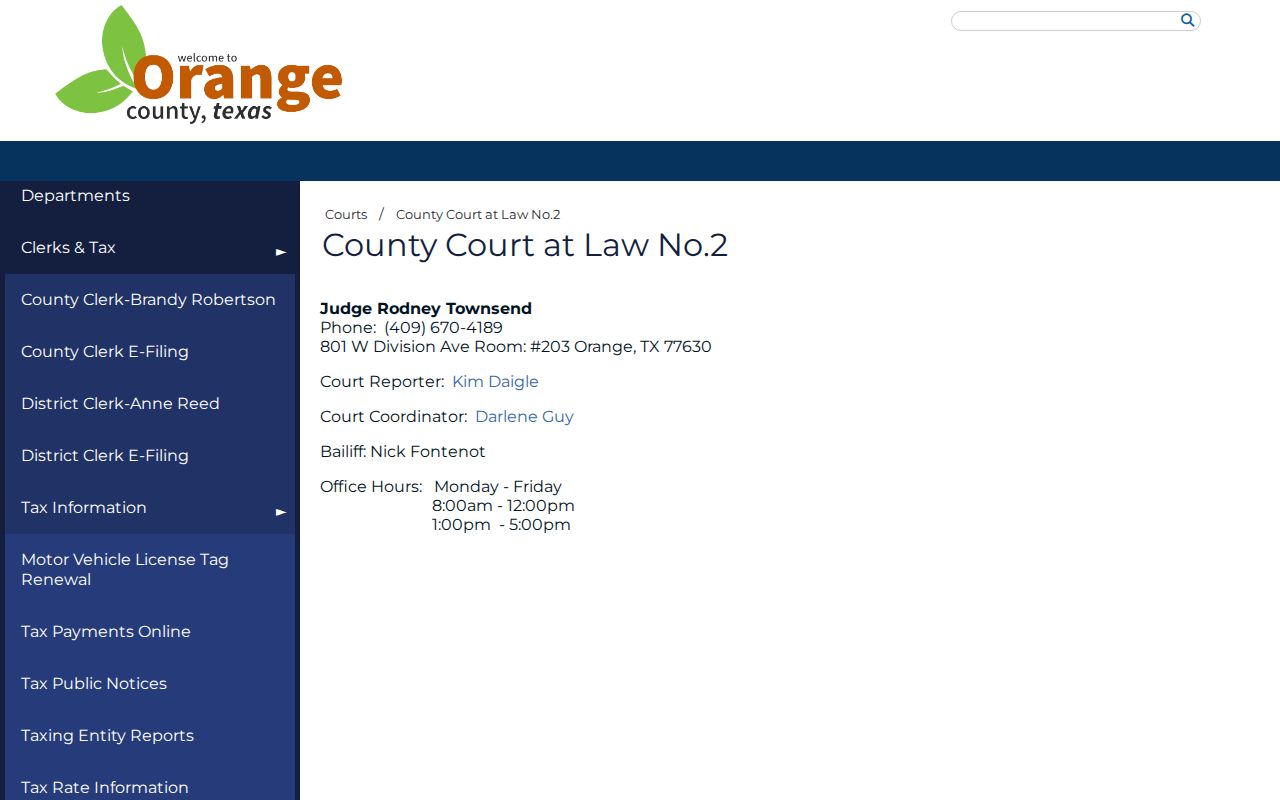
The official panel helps route a setting question to the right desk. It cannot replace the County Clerk's probate index or the filed hearing packet.
Types of Civil Cases on the Docket
Orange County civil dockets cross more than one court level. District courts take general civil suits, family matters, and delinquent-tax cases. County Courts at Law handle county-level civil and probate matters. The County Clerk FAQ lists a County Court at Law civil range of $500 to $200,000. Filers should confirm current statutory jurisdiction first. Justice courts hear small-claims suits up to $20,000. Justice suits belong there too, along with forcible-entry-and-detainer and property-seizure matters.
- District civil claims and delinquent-tax proceedings
- Family and domestic-relations cases handled by the District Clerk
- County Court at Law civil suits within the published local range
- Probate proceedings maintained by the County Clerk
- Justice and small-claims matters in the proper JP court
Case type decides where the docket lives. A hunt limited to the County Clerk will miss a district suit, and a re:SearchTX result may not surface an older or lower-court file.
Orange Try-or-Dismiss Clock
The Orange County civil rules build a local docket-management rhythm. A district civil case can sit untouched for one year. That means no disposition and no current action. It may then land on a try-or-dismiss docket. County and Statutory County Court civil cases hit that point at six months. Domestic-relations cases carry a six-month nonjury-docket rule. None of these marks means automatic dismissal. They set a hearing on readiness or the lack of action. A setting line can thus signal a management event rather than a merits hearing. The 163rd District Court page identifies one of the court teams that handles district settings.
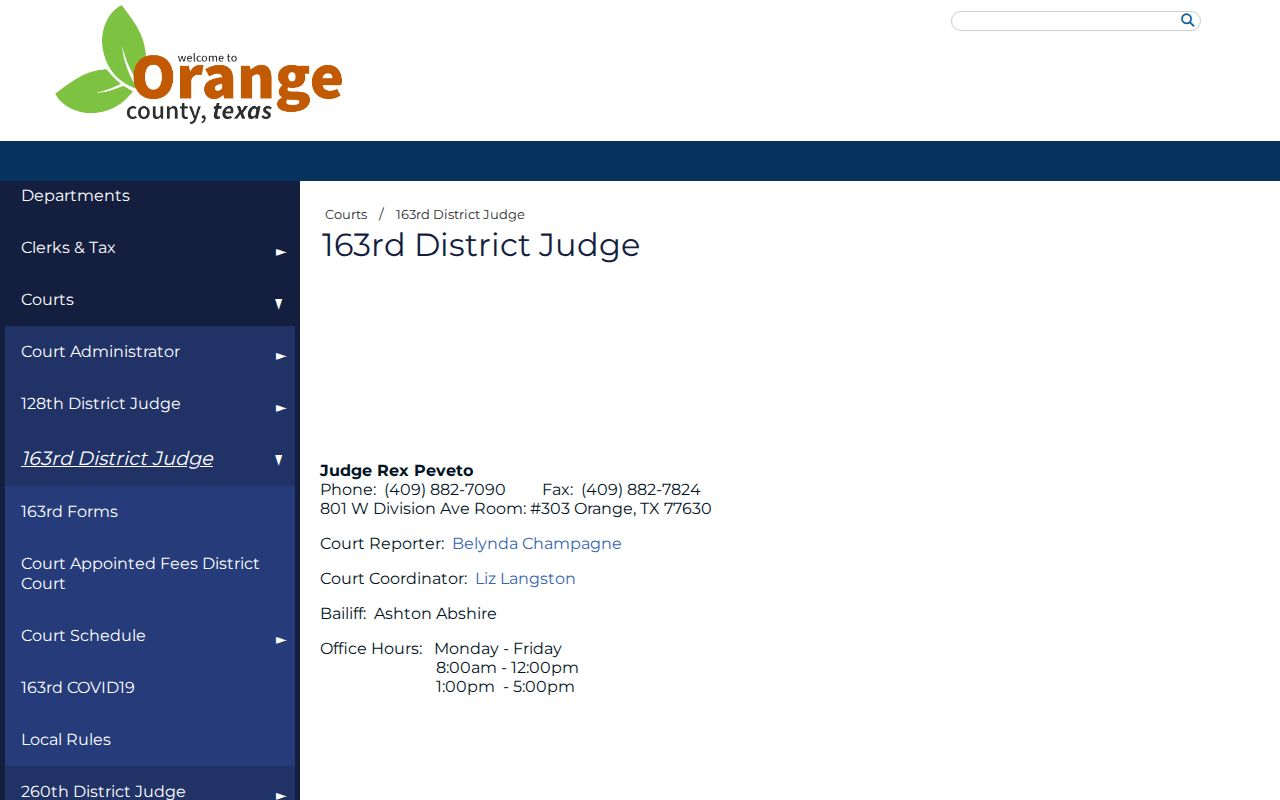
The official panel ties a docket to coordinator Liz Langston in Room 303. If the event history shows a stale date or no future setting, contact the current court office.
Settings and Hearings on Civil Dockets
Civil settings in Orange County come in several flavors. There are motion hearings, status conferences, try-or-dismiss calls, jury docket calls, and trial placements. Jury docket call is set by local rule. It happens at least ten days before the first trial week. Its job is to sort ready cases and set the trial docket's order. A party confirms readiness as the rule allows. Skipping that step can knock a case off the trial docket.
A reset only means the prior setting changed. The case is still alive. Per the County Clerk FAQ, the clerk cannot reset a hearing for you. Call the coordinator for the specific court. Then check that answer against any later written notice or docket entry. For one example, the 260th District Court page lists Judge Steve Parkhurst, coordinator Georgette LeBouff, and Room 304.
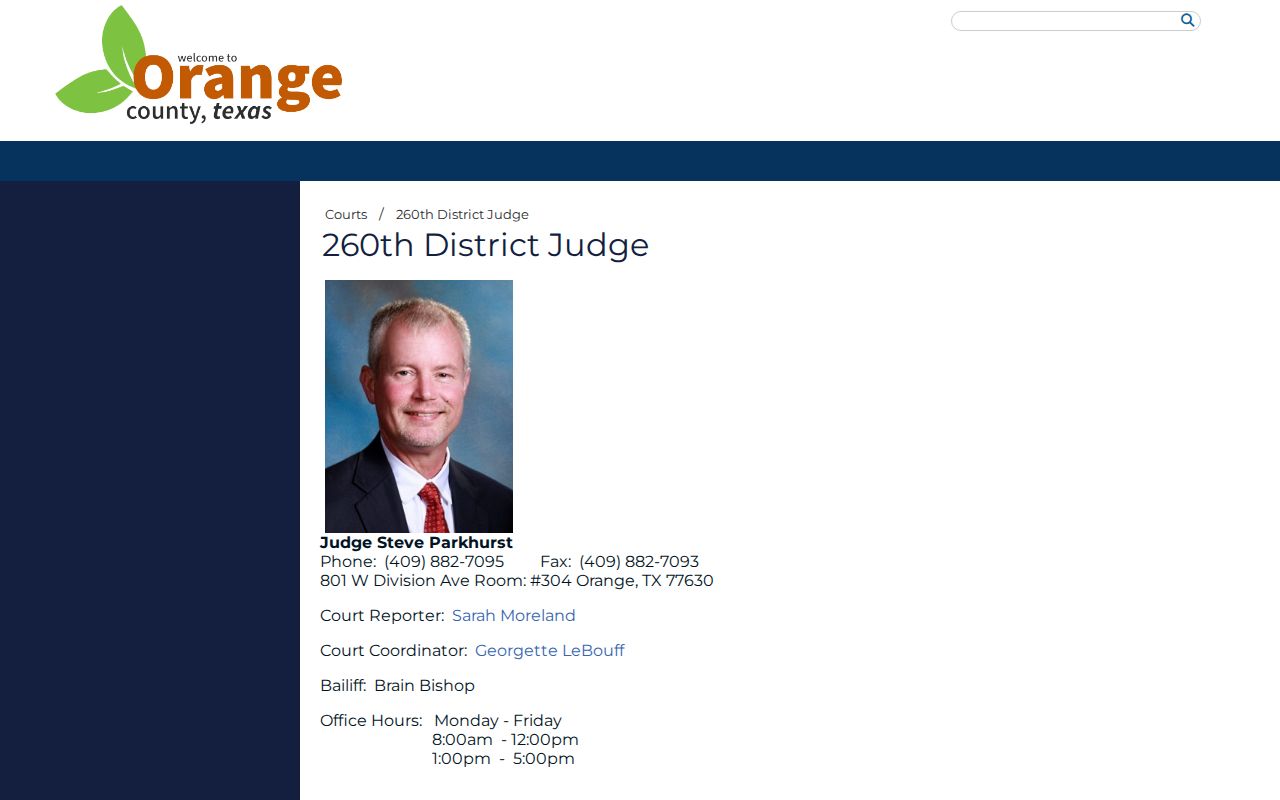
That court-specific route beats assuming one Orange County calendar governs every court. Note: Confirm readiness and the operative date with the assigned Orange County court before any civil docket call.
Orange Civil Filing Fees
The Orange County Clerk's civil fee schedule is dated January 1, 2022. Treat it as a reference, since charges can change. Ask the clerk for the current total before you file or mail payment, especially if you need service.
| Published item | Amount effective January 1, 2022 |
|---|---|
| New civil case | $350 |
| Issued citation | $8 |
| Sheriff or certified-mail service | $80 |
| Contest, adverse claim, or counterclaim | $80 |
| Subpoena | $8, plus service where applicable |
| Abstract of judgment | $8 |
| Writ execution | $8, plus $175 sheriff service |
Those are filing and process charges. A docket search costs extra. The County Clerk separately lists a $5 name search, $1 per plain-copy page, and $5 added for certification per case or document.
Public Access to Civil Dockets
Orange County civil court records are presumed open. Some filings are not. Papers may be sealed, restricted, confidential, or redacted, and family, probate, juvenile, medical, protected-address, and identity data can call for special handling. Portal access also varies with which courts participate and how records are formatted.
Texas civil access:
Texas Judicial Branch open-records policy explains that Rule 12 applies to judicial administrative records, while court case records are requested from their custodian.
Texas Government Code Chapter 552 recognizes the judiciary's separate records regime.
Texas Rule of Civil Procedure 76a presumes court records open and sets findings required for sealing.
Which rule applies to a given document? Ask the Orange County District Clerk, County Clerk, or lower-court clerk. And don't assume a hidden image or blank portal result means the whole case is sealed.
Orange Civil Record Layers
A docket event, a pleading, an order, and a certified copy are four different things. The event is just an index line. A pleading shows what a party filed. An order or judgment records what the court directed. A certified copy is the clerk's authenticated reproduction of the filed record. Telling these layers apart prevents a common Orange County search mistake.
| Record layer | Best use | Source |
|---|---|---|
| Docket event | Track chronology and locate a filing date | Case system or clerk index |
| Pleading | Read a party's filed request or response | Responsible clerk |
| Signed order | Read the court's operative ruling | Responsible clerk |
| Certified copy | Obtain clerk-certified form | Responsible clerk |
County Clerk copy requests go in person or by mail with the style, case number, and file date. The District Clerk posts no comprehensive fee sheet, so ask that office directly for the current fee, payment method, and turnaround.