
How to Search Criminal Dockets
Every Orange County criminal docket search starts with one question: what level of court holds the case? Felonies sit with the Orange County District Clerk. Misdemeanors in County Court at Law belong to the Orange County Clerk. Fine-only Class C matters stay with the named Justice of the Peace or municipal court. The county-linked iDocket system can point you toward district and county cases, but the responsible clerk is still the place to confirm what you found.
If you have the cause number, use it. Keep its punctuation exactly as written. Without a number, a name plus the court, offense level, and a rough filing date will narrow things down. Then follow each Orange County case event in order. A matching name alone is never conclusive.
- Read the citation, notice, or prior order to identify the court.
- Use the Orange County iDocket entry or the correct clerk's office to search by cause number or name.
- Compare the court, party role, filing date, and charge description before opening a match.
- Review settings, pleas, motions, disposition, sentencing, costs, and appeal markers.
- Ask the custodian for the exact filed document when a docket line is not enough.
Neither clerk's office will run a docket search for you over the phone or by email. County Clerk staff instead offer public computers and index books for self-searching, and they accept written mail requests. For felony questions, District Clerk staff point you to the dedicated criminal counter.
Orange Felony Docket Counter
Felony filings in Orange County live with the Orange County District Clerk. That office holds pleadings, warrants, capias records, and subpoenas. It also keeps judgments, costs, and appeal papers for the district courts. Call the felony line at 409-882-7817, or the main office at 409-882-7825. The counter sits at 801 W. Division Avenue in Orange. A portal record may be missing, unclear, or too old to pull online. This office is the direct fallback then. The District Clerk's official page explains how Orange County assigns these records. It also shows the office's published view.
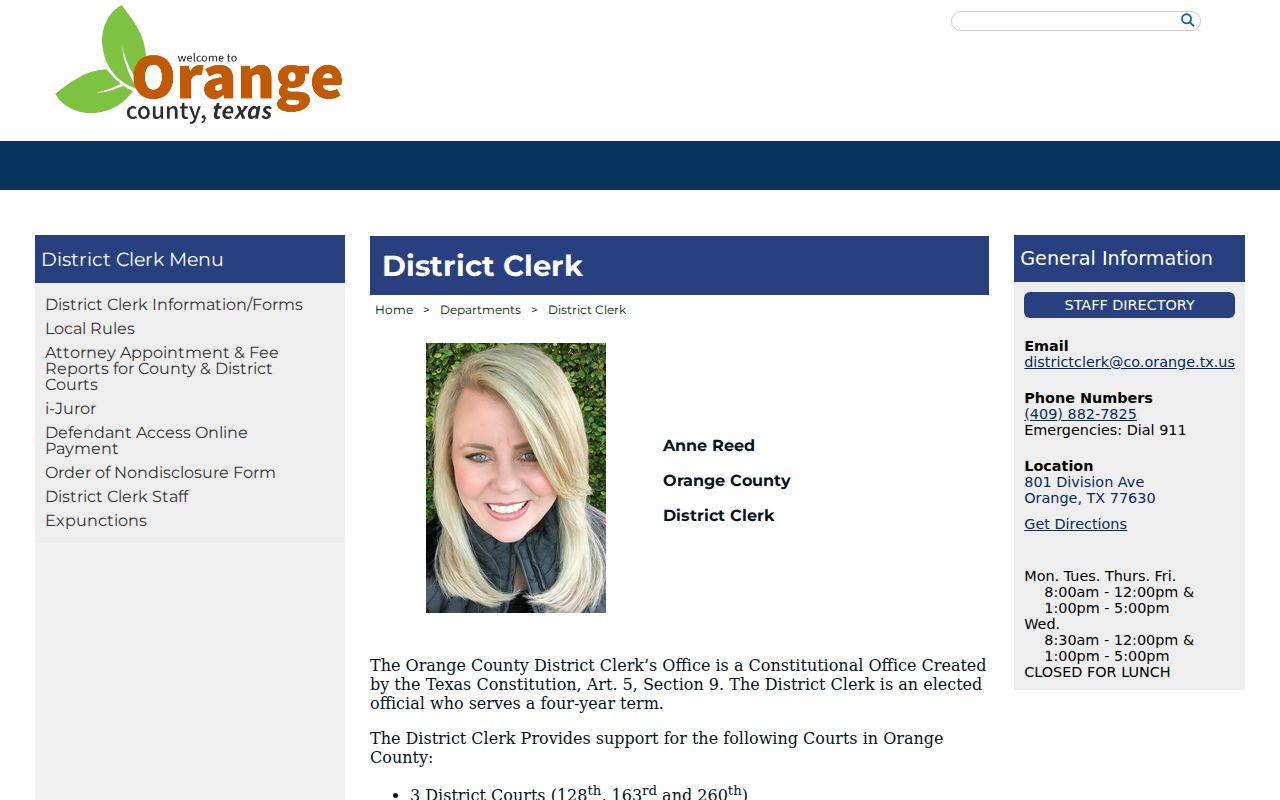
The takeaway is simple: a felony case is a District Clerk record, even when a county-linked vendor helped you find it. The clerk can tell you which district court holds the case. Staff can also explain how to request a specific public filing.
What a Criminal Docket Shows
Think of a criminal docket as a chronology rather than a story. Entries in Orange County may cover the charging instrument, appearances, appointed counsel, motions, resets, pleas, disposition, sentencing orders, costs, and an appeal. Read each label in its case context. The county publishes no list of its own event codes.
| Cause Number | The primary locator, shown exactly as assigned, such as court-issued cause number. |
|---|---|
| Charge | The filed indictment, information, or offense category, not proof of the final outcome. |
| Case Event | A dated filing, return, motion, order, setting, reset, plea, or other action. |
| Setting | An arraignment, pretrial, trial, or sentencing date that should be confirmed with the court. |
| Disposition | The status or outcome, with the signed judgment or order supplying the operative text. |
| Access Flag | An image, copy step, redaction, restriction, or sealed-record indicator. |
Warrant and capias entries deserve extra care. The Orange County JP warrant page tells people to call the issuing office first to verify a balance before paying online. Note: a dated event on the docket may describe past activity, not the next Orange County criminal court date.
Orange Misdemeanor Search Route
Misdemeanor files from County Court at Law are Orange County Clerk records. The clerk's FAQ says those files are open to the public. A staff name search costs $5. Copies of civil, probate, and criminal records can be requested in person or by mail. Give the case style, cause number, and file date. Plain copies run $1 per page, and certification adds $5 per case or document.
County Court at Law 1 meets in Room 104 at 801 W. Division Avenue. Judge Mandy White-Rogers presides, with Jessica Myers as coordinator. The court's official panel appears on that page.
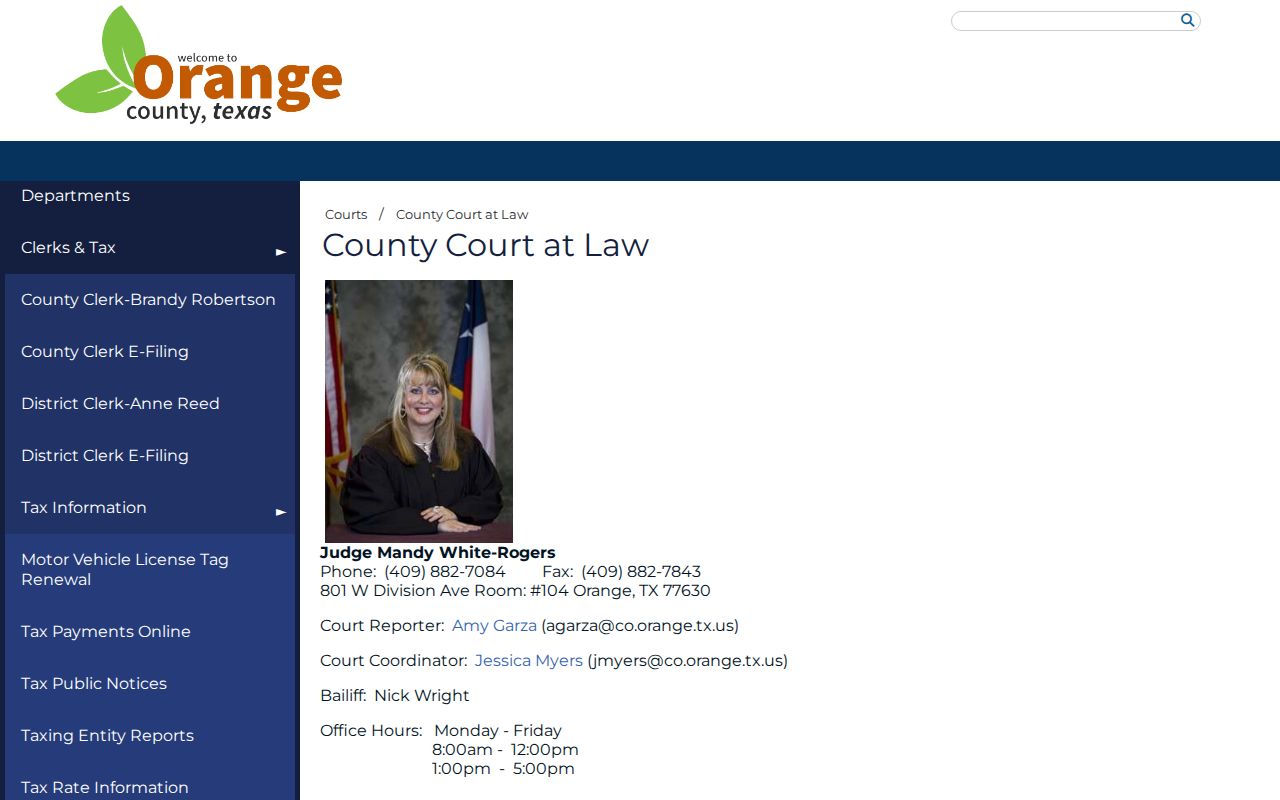
The panel helps you confirm the court and its coordinator. Still, the Orange County Clerk holds the misdemeanor file itself. County Court at Law 2 is a separate court. So name the specific court in any request. Writing only "county court" invites delays.
Stages on a Criminal Docket
The exact sequence varies with the charge and the rulings along the way. Even so, Orange County criminal dockets tend to move through familiar groups of events. A filed indictment or information marks the formal charge. Service, bond, warrant, or capias entries may come next. An arraignment or appearance records the plea stage. Pretrial settings then carry motions and scheduling steps toward a plea or trial.
Docket flow: Filing › Arraignment › Pretrial › Plea or Trial › Disposition › Sentencing
Not every case touches every step. A reset just moves a setting; it changes nothing about the charge. A dismissal entry does shift the case status. But the signed dismissal order holds the full terms. The same goes for sentencing, where the entry points to a filed judgment. Request that document whenever its details control another court matter.
Orange Criminal Docket Activity
Raw new-case counts can mislead anyone reading about Orange County docket work. The Texas Office of Court Administration's fiscal 2024 district activity summary makes that plain. Its reporting period ran from September 1, 2023, through August 31, 2024. District criminal activity included heavy movement between reactivated and inactive placements.
The report also lists 647 cases placed inactive. Don't add those numbers together and call them "new cases." Each tracks a distinct change in Orange County criminal docket status over the fiscal year.
Which Court Holds Criminal Dockets
Criminal dockets in Orange County live in three separate lanes. Felony cases sit with the District Clerk. That clerk's work spreads across the 128th, 163rd, and 260th District Courts. Misdemeanors belong to the County Clerk, filed in County Court at Law 1 and 2. Below that sit the lower courts. Four JP courts and several municipal courts run their own Class C and traffic dockets. Whichever lane holds the charge is the lane for you. Your docket search has to stay in that lane.
| Case level | Court | Record custodian |
|---|---|---|
| Felony | Orange County District Court | District Clerk |
| Misdemeanor | County Courts at Law | County Clerk |
| Fine-only or Class C | Named JP or municipal court | That court's clerk |
Do not count on the statewide portal for a full criminal index. The re:SearchTX repository excludes criminal records in general, according to Texas Judicial Council reporting. Orange County does point filers there for participating e-filed cases. For a felony or misdemeanor lookup, though, the proper local clerk still holds the record. That is the office you need.
Orange Filing Search Boundary
Orange County makes electronic filing mandatory for civil, probate, and criminal filings, and its local e-filing instructions walk users through the process. eFileTexas carries the filing envelope to the court. That is where the similarity to a public docket ends. Transmitting a document does not create a certified clerk copy. The county's official page places its e-filing and re:SearchTX links side by side, and that page shows the current notices for both systems.
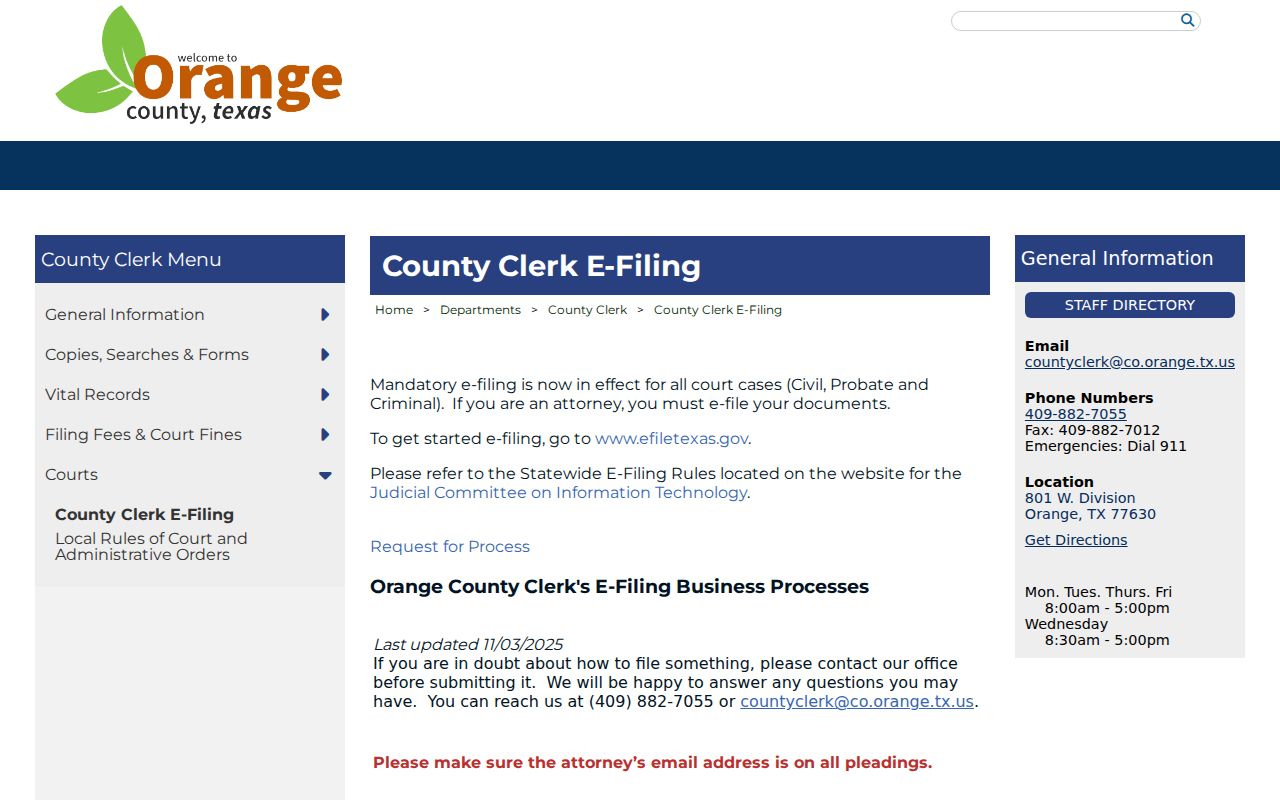
Seeing those systems linked together is helpful, but the jobs stay distinct. eFileTexas takes in papers. A case system logs what happens to them. The Orange County clerk keeps the actual court record, and a rejected filing or restricted document may never surface as a public event the way a searcher expects.
Public Access and Sealed Criminal Dockets
Orange County misdemeanor files are treated as public by the County Clerk. Even so, the view can be blocked. A sealing order, an expunction, juvenile confidentiality, redaction, or some other law can limit what you get to see in the criminal docket. A blank result does not prove the case never existed. It can also mean the docket search simply went to the wrong clerk or portal.
Texas access rules:
Texas Judicial Branch Rule 12 policy separates judicial administrative records from the case records held by a court clerk.
Texas Government Code Chapter 552 recognizes the judiciary's separate access regime.
Texas Rule of Civil Procedure 76a supplies the cited framework for sealing civil court records, while criminal restrictions and expunctions follow their own authority and orders.
The custodian can tell you whether an Orange County criminal record is public, redacted, restricted, or sealed. Asking for the whole file does not unlock protected content.
Orange Expunction Record Change
Expunction is not the same thing as a dismissal. The Orange County District Clerk expunction page lays out the process. A court has to authorize it first. Then arrest, charge, or conviction records can be removed or destroyed from public access. The page also flags a service change under Senate Bill 1667, effective September 1, 2025. That same official page carries the current service notice.
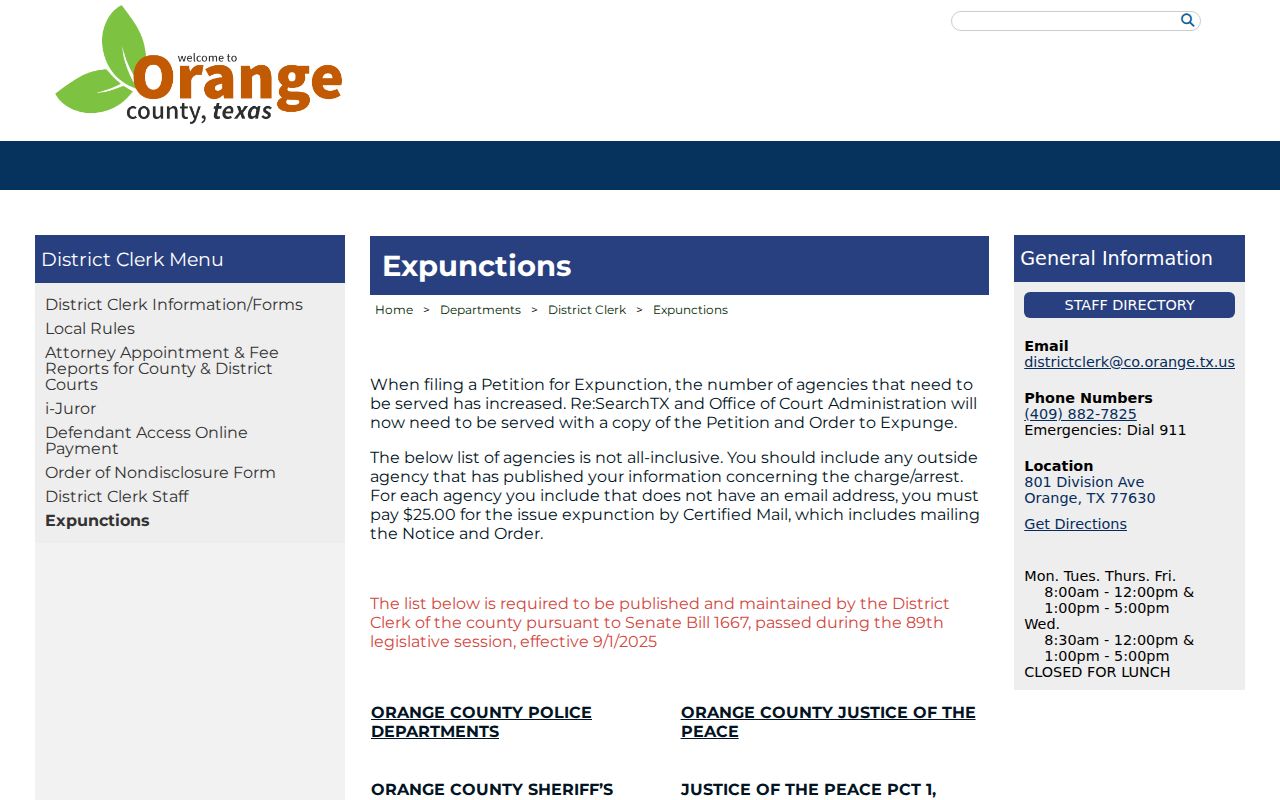
After an expunction, the public docket goes quiet. Read the absence through the signed order and the custodian's response instead. Do not guess from a vendor search. JP 3 youth diversion records hold a different confidential status under the local 2025 plan. Expunction there is automatic at age 18, except for statistics. Note: Ordering an Orange County criminal copy by mail? Confirm what another court's certification requires first.